
New Medieval Publications
Here are three recent publications from BAR Publishing’s Digital Collection that may be of interest to Members. Follow the links for each title for further information and details on how to access the publications.
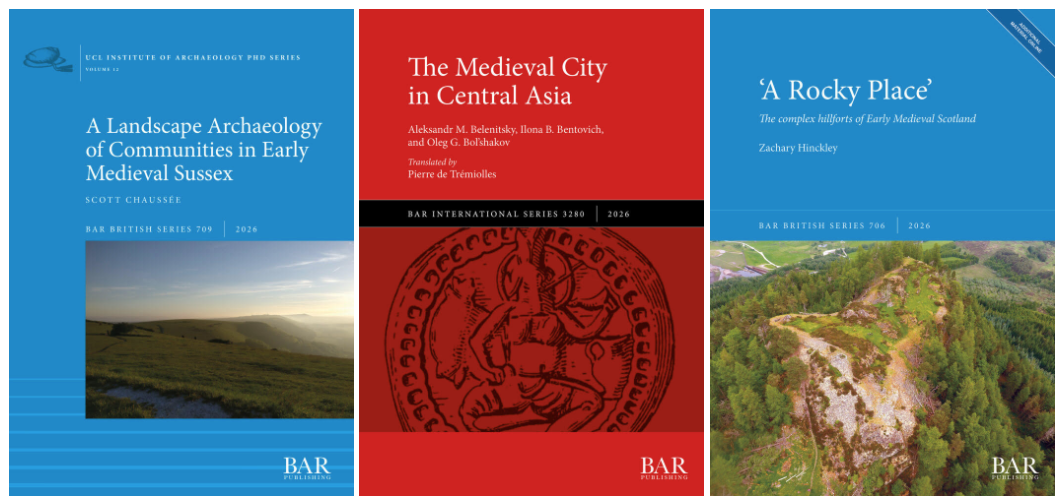
A Landscape Archaeology of Communities in Early Medieval Sussex written by Scott Chaussée examines the material reflections of community identity and the dynamics of social change in post-Roman southern Britain, with special reference to the area which would later become the ‘Anglo-Saxon’ kingdom of Sussex. Sussex was an important zone of socio-political interaction in south-eastern England, but the nature of its political transformation from a Roman civitas into an Anglo-Saxon kingdom was, until now, poorly understood. For the first time, this book brings together reinterpretations of published archaeological literature and new datasets derived from a novel combination of settlement, cemetery, and chance-find sources. A multi-scalar, geospatial approach is applied to produce original diachronic and qualitative distributional analyses of key artefact classes (coinage and portable metalwork) and micro-scale multivariate analyses of individual cemetery sites. Through the lens of socio
political interaction and kingdom formation, this research finally addresses the strategies communities pursue in mediating themselves, their lives, their descendants, and their ancestors in the world.
The Medieval City in Central Asia written by Aleksandr M. Belenitsky, Ilona B. Bentovitch, and Oleg G. Bol’shakov (translated by Pierre de Trémiolles) delves into the architectural and social changes which affected cities located throughout Central Asia between the 7th and the 13th centuries. These changes stemmed from the two most notable political events which shook the region during that period, namely the Arab conquest and the Abbasid Revolution. It also describes the art and craft performed by the inhabitants, from glassblowing and jewellery to bone carving and pottery. Most of the excavated material illustrated in this book comes from the city of Panjikent. A glossary of key terms from the various Eastern languages used (Arabic, Persian, Sogdian, Sanskrit, and Turkic) has been added. The appendix also provides a pyramidal illustration of the castes which made up Sogdian society prior to the Arab conquest.
‘A Rocky Place’: The Complex Hillforts of Early Medieval Scotland written by Zachary Hinckley The hillfort is predominately viewed as an Iron Age structure, however (re)occupation and de novo constructions began to appear in Scotland between the 5th and 8th centuries AD. The re-emergence of hillforts coincided with drastic upheaval of societal and cultural changes in Early Medieval Scotland and Europe. Based on R.B.K. Stevenson’s (1949) definition of the ‘nuclear’ fort, this book creates the first comprehensive database of sites that have characteristics of the original definition. Excavations in the 1980s proved that some ‘nuclear’ forts were of Early Medieval date, however, recent excavations suggest that this morphology began sometime in the Middle Iron Age. Few of these sites – just over twenty – have been identified since. Excavation at six sites in the database took place with radiocarbon dates from each adding to the growing number of radiocarbon dates for these sites. The excavated sites were Craig Rock, Dunmore and Norman’s Law in Fife, Mither Tap of Bennachie and Craig Dorney in Aberdeenshire, and Dunsinane Hill in Perth and Kinross. These excavations, along with drone survey and photogrammetry of other forts, shed light on this enigmatic site type. Despite a lack of radiocarbon dates outside of Pictland, new insights and information suggest that the ‘nuclear’ morphology of hillforts began sometime in the Middle Iron Age and continued through to the Early Medieval period. The author suggests specific attributes that can help distinguish between Iron Age or Early Medieval complex forts.
Latest News
New Medieval Publications
Here are three recent publications from BAR Publishing’s Digital Collection that may be of interest to Members. Follow the links for each title for further information and details on how to access the publications. A Landscape Archaeology of Communities in Early Medieval Sussex written by Scott Chaussée examines the material reflections of community identity and the
The 2026 Annual General Meeting and Winter Symposium
We are delighted to announce that this year the Society will trial a hybrid Annual General Meeting and Winter Symposium. For some years these events have taken place online only, however, we have decided to hold a combined in-person and online event this year to increase the opportunities for members to meet and network. The