Medieval Archaeology 69.1 now available!
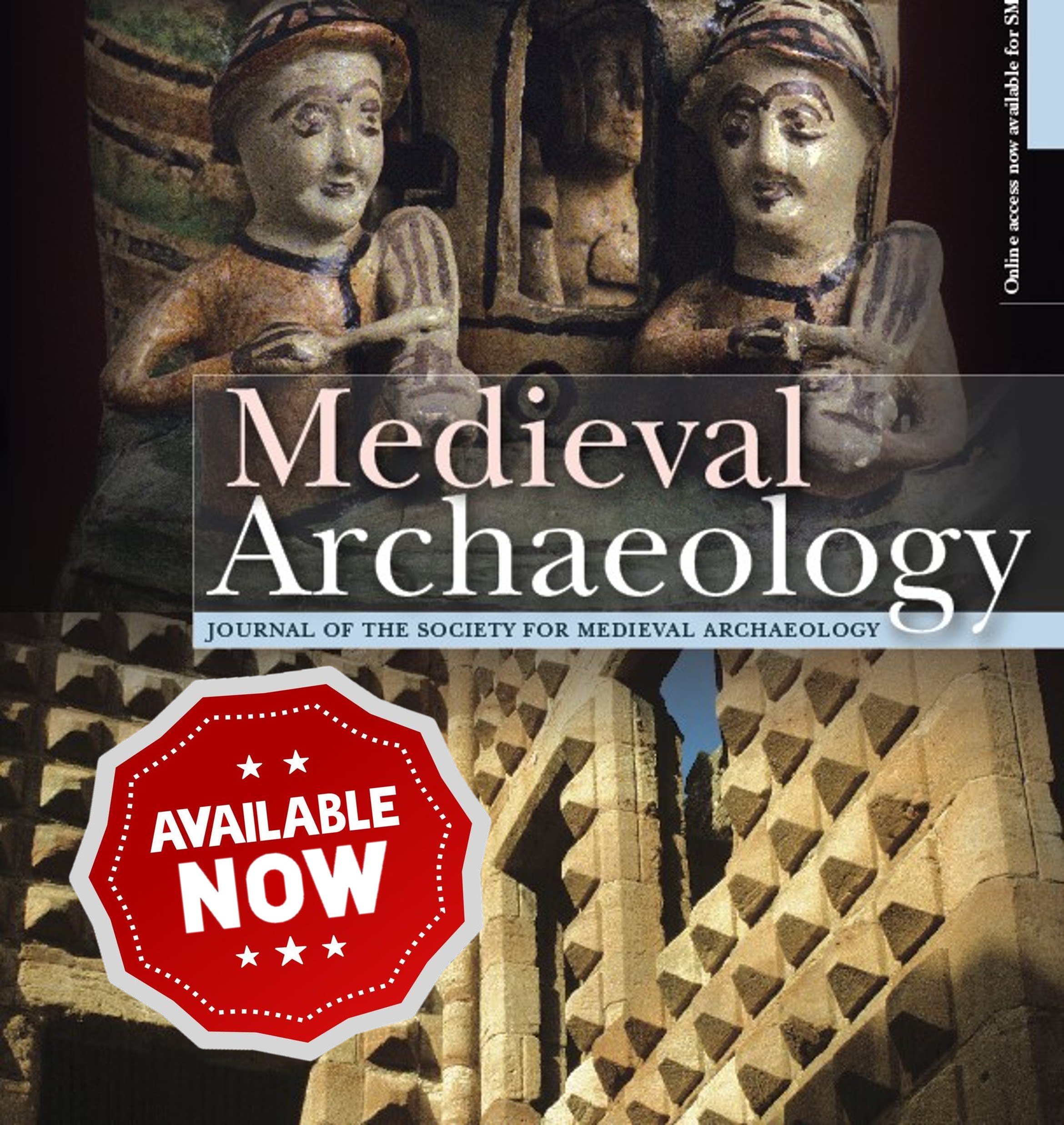
We are very pleased to announce that issue 69.1 of Medieval Archaeology has now been published online and the print copy should be arriving with members shortly. The content in this issue includes six original articles focusing on new research from Britain, Belgium, Central Eurasia, Iberia, and Norway and covers both the early and late medieval periods. In addition, there are 15 reviews of books on medieval topics from across Europe, which will keep readers up to date with the latest published research. This is the first volume published under the new editorial team of DUncan Wright and Katie Hemer and they hope that you enjoy reading it as much as they did producing it.
The issue starts with an article by David J. Govantes-Edwards, Adolfo Fernández Fernández and Chloe Duckworth that reviews the position of the north-western Iberian Peninsula in trade networks in the European Atlantic façade in the 6th and early 7th centuries ad, particularly the role played by the harbour of Vigo. For the first time, the position of glass in this trade is examined in light of both archaeological and historical records, and through the chemical analysis of an assemblage of 20 glass samples. Suggestions are put forth concerning the possible role played by the Iberian north-west and the political events in the region at the time of the arrival of eastern and central Mediterranean imports in Atlantic Europe.
Florin Curta’s article discusses how major advances in molecular anthropology, isotope analysis, paleobotany, and pollen analysis have impacted our understanding of the archaeology of nomadism, with a move away from the ‘nomadic model’ to ‘agro-pastoralisim’. But where does this leave the study of medieval nomads? Using case studies from the steppe lands north of the Black Sea, and in the Carpathian Basin, Florin explores possibilities in the study of medieval nomads and tracks avenues of future research on yaylag pastoralism (transhumance).
Despite their ubiquity, the character and function of small towns in medieval England continues to provoke debate. In his article, Ben Jervis draws upon recent analyses of modern European small towns, and proposes a new approach to this debate. The paper begins with an assessment of the potential and limitations of hierarchical approaches to medieval towns. An analysis of towns in relation to their size and proximity to other towns is presented, using a case study of 12th–15th century Gloucestershire and Wiltshire. This demonstrates the variability of these towns, and reveals some of the factors which underpin this diversity. The paper closes with a consideration of how we might perceive urbanisation as a process of difference-making, as an alternative to approaches which neutralise difference through hierarchical or typological classification.
Maxime Poulain, Mathijs Speecke, Anton Ervynck, Jan Huyghe, Jan Moens, Marissa Ledger, Eva Vermeersch, Lieselotte Desnerck, An Lentacker, Wim Wouters, Wouter Van Der Meer, Koen Deforce, Toon De Meester, Nicolas Thomas, Marijn Stolk, Ina Vanden Berghe, Maaike Vandorpe, Alejandra Gutiérrez, Peter Vandenabeele, Wim De Clercq and Bieke Hillewaert then present an interdisciplinary study of a 1996 rescue excavation of a cesspit in Bruges’ SPanish nation house. The refuse in the cesspit is what is left of several generations of traders documented at the site from the 1480s onwards, and sheds new light on life in the city’s international district between the late 14th and early 16th century.
The focus then shifts to Scandinavia, where Markus Nilsen delves into the use of fire beacons in Norway in the Viking and Middle Ages. Fire beacons have long been a highly effective method for long-distance communication but research on the Norwegian beacons is minimal. This article surveys place names, archaeological evidence, and written sources to locate and authenticate beacons from the Viking Age and Middle Ages (c ad 800–1500) around the Trondheim Fjord in central Norway. A coherent beacon system is identified and compared with similar systems in England and Denmark.
Finally, Peter Pentz looks at a small, unnoticed bearded figurine that is carved from a walrus tusk and was discovered in 1796 in a burial mound at Flygstad, southern Norway. He examines a highly controversial group of beard-stroking figurines, or pulling on a beard, dating back to the early Middle Ages and the Viking period, and argues that the figurines are pawns, more precisely kings, to play the game of “hnefatafl”. It is suggested that the symbolism of the beard, whether stroked or touched, is closely related to the concept of masculinity, royalty, and fertility.
The articles are followed by Medieval Britain and Ireland in 2024, and 15 book reviews of recent publications on medieval topics from across Europe, which will help readers keep up to date with the newest research in the field.
Medieval Archaeology 69.1 can be accessed online here.
Latest News
2026 Jarrow Lecture – Bede, Providence, and Early Medieval Kingship
Announcing this year’s Jarrow Lecture: Bede, Providence, and Early Medieval Kingship This year’s lecture will be delivered by Dr Tom Pickles, Associate Professor of Early Medieval History at the University of Chester. It will take place on Friday 22nd May 2026 at 7:30pm at St. Paul’s Church, Jarrow (NE32 3DZ). Free entry and refreshments provided.
Wiltshire Pottery Type Series – Available Now!
Type series of medieval and post-medieval pottery for Wiltshire (c. 400–1700) The type series consists of sample sherds of pottery found (but not necessarily made) within the county, and an accompanying database with descriptions of wares and fabrics. It includes, for example, Saxon handmade wares, medieval Laverstock wares from the Salisbury area and post-medieval slip-decorated